

The transformation of the battlefield into an increasingly transparent environment does not affect military doctrine alone. It directly influences defence industry requirements, development models, and the way future UAV ecosystems are structured.
Lieutenant Colonel Jaakko Kauppinen, Inspector of Army Aviation & UxS, addressed the development of UAV systems and the ongoing transformation at the Mikkeli Drone Seminar on 14 April 2026. Both his presentation and the subsequent interview revolved around a clear conclusion: defence capability is no longer built through closed development programmes, but through broad cooperation networks and ecosystems.
Transparency, rapid technological development, and economic sustainability together form a structural shift that is forcing the defence sector to rethink its operating models.
Kauppinen places particular emphasis on the role of local industry in the Finnish defence context. Finland’s geographical position makes security of supply a core element of military capability.
"Due to Finland's geographical position, security of supply is paramount. Consequently, the role of local companies and their ability to manufacture and produce systems is critical. As we have observed in Ukraine, the situation would be vastly different without the contribution of volunteer initiatives, small businesses, and local production capacity."
The war in Ukraine has demonstrated that the ability to manufacture, repair, and replace systems rapidly can be decisive in a prolonged war of attrition. This reality also shapes the Finnish Defence Forces’ partnership strategy and industrial choices.
A clear shift has taken place in UAV innovation. According to Kauppinen, the war in Ukraine has accelerated the transition toward a model in which the private sector and innovative companies set the pace of development.
The Defence Forces have had to change their approach: instead of defining fully specified system requirements, companies are now presented with concrete use cases and operational challenges, which are addressed collaboratively.
"As we have all seen in Ukraine, the driver of military capability development has shifted. It is no longer just about internal military requirements and slow technology cycles; instead, the pace is now set by the industry and innovative startups. This has created a need to move away from traditional requirement definitions toward presenting specific use cases and operational challenges to companies."
This shift requires a new level of agility from the defence sector – and an ability from companies to respond rapidly to evolving operational needs.
Testing and demonstration events have become a central component of this new operational model. Kauppinen stresses that their value extends far beyond technology demonstrations; they are an integral part of system development.
"Naturally, this is a collaborative effort. It involves organizing testing and demonstration events that provide sufficient feedback to further develop and refine the systems."
Testing enables fast feedback loops that allow systems to be refined, adapted, and evaluated under realistic conditions. This is particularly critical in an environment where technological advantage is measured in weeks rather than years.
The role of seminars has also evolved. According to Kauppinen, they increasingly function as active meeting platforms where new partnerships and development ideas emerge.
"Seminars are vital for building relationships, engaging with different companies, and discovering innovations or solutions that may not have been previously considered."
From the Defence Forces’ perspective, the greatest value is created when companies also find one another and are able to build integrated solutions instead of isolated products.
"Naturally, our hope is that companies also find ways to collaborate with one another, creating integrated solutions that enhance the overall performance of the end product."
Autonomous drones and AI integration are central upcoming themes in the UAV sector, but Kauppinen introduces a pragmatic perspective.
"While autonomy is important, companies should focus on their core strengths to develop functional solutions, balancing rapid development with cost."
The specific characteristics of the Finnish defence environment – most notably a large reserve force – set clear constraints on viable solutions. Economic scalability, sustainability, and simplicity become critical requirements.
"Finnish Army’s large reserve forces specifically require solutions that are sufficiently simple and, above all, have a reasonable price point. Ukraine has demonstrated that quantity has a quality of its own compared to individual high-end capabilities – though, of course, this does not rule out the need for high-tech products."
The development of unmanned systems is no longer about procuring individual platforms, but about continuous collaboration, testing, and adaptation.
Defence capability does not emerge from a single perfect product, but from an ecosystem in which the military, industry, research institutions, and allies learn and evolve together – faster than the adversary.
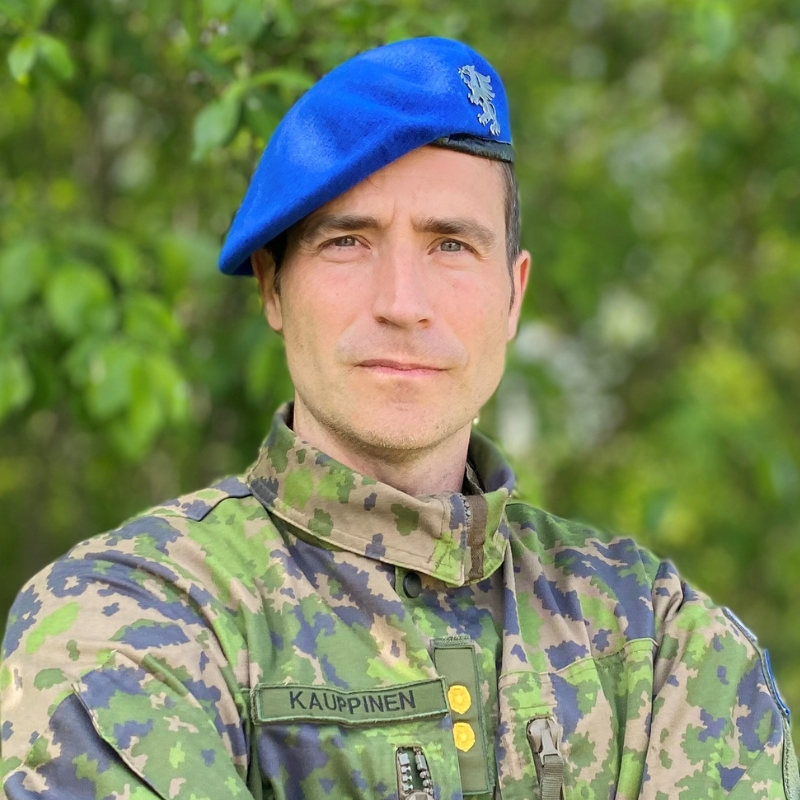
Army Aviator (Helicopter pilot)
Helicopter Company Commander
Commanding officer of Helicopter battalion
Chief of Army Aviation
Since 2023 with UxS systems. Responsibility for capability development
